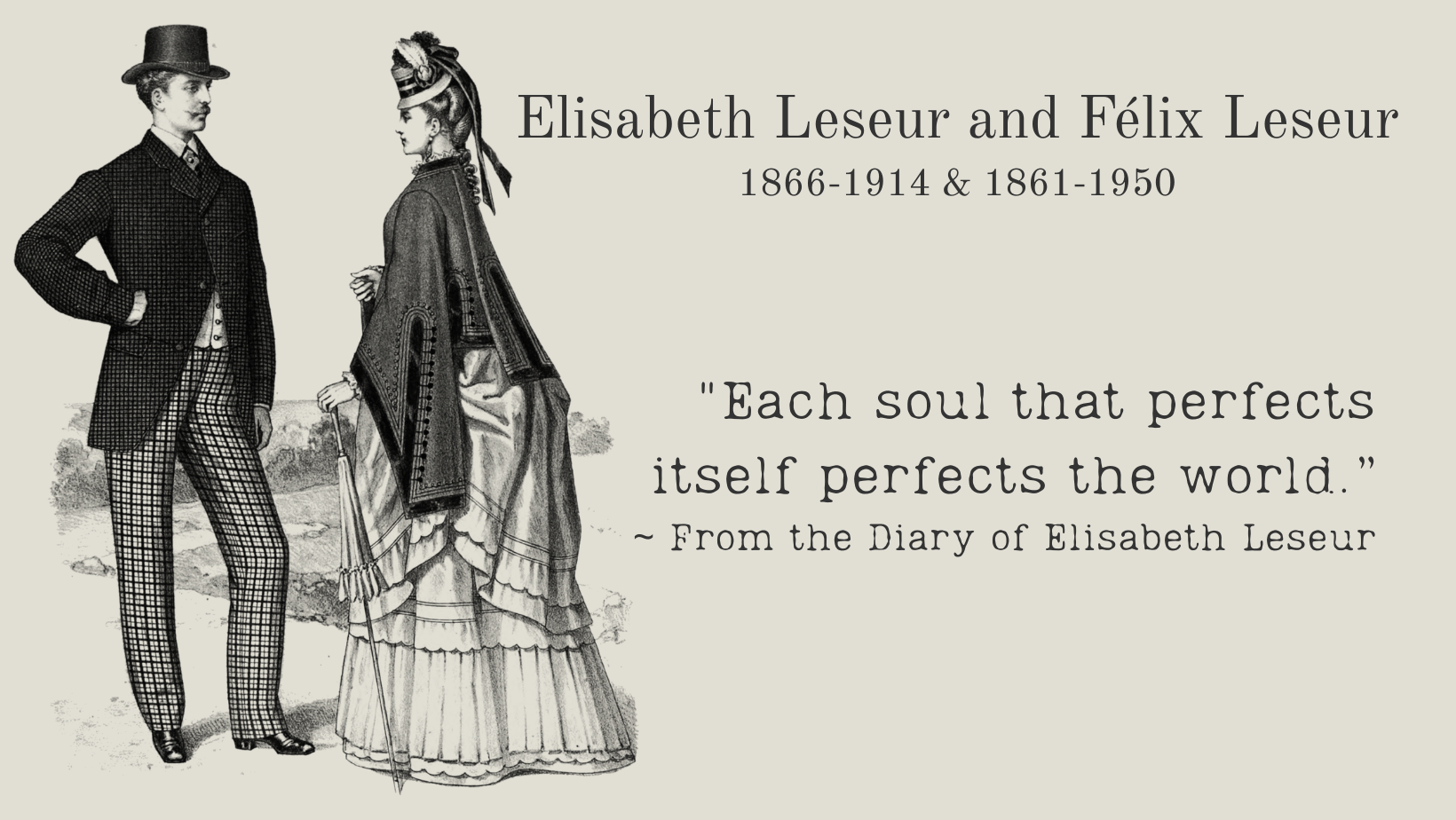
Elisabeth Leseur and Félix Leseuri
(1866-1914 & 1861-1950)
Elisabeth Arrighi Leseur is a Servant of God whose beatification cause was opened in 1934 and reopened in 1990. She exemplifies how a wife’s hidden prayers and sacrifices can transform even the most hostile spouse.
A Marriage of Opposites
Elisabeth, born into a wealthy Parisian family in 1866, married Dr. Félix Leseur in 1889. Just before their wedding, Félix confessed that he had lost his Catholic faith during medical school and was only practicing “to keep up appearances.” Elisabeth, whose faith was then merely conventional, didn’t mind – they were deeply in love.
However, as time passed, Félix became increasingly militant in his atheism, filling their home with atheistic books and openly mocking Elisabeth’s growing devotion. Their marriage became a spiritual battleground, with Félix determined to “free her from religious superstitions” and Elisabeth equally determined to bring him back to Christ.
Hidden Sanctity
Elisabeth adopted the motto: “Each soul that perfects itself perfects the world.” Rather than argue with her husband, she chose the path of silent sacrifice and hidden prayer. She wrote in her secret diary: “My God, one day…soon…You will give me the immense joy of a full spiritual communion with my beloved husband—the same faith, and a life for both him and me that may be directed towards You!”
In 1911, she made the ultimate sacrifice, offering her life for Félix’s conversion: “In 1905 I begged Almighty God to send me sufferings with which to pay the price of your soul. The day I die, that price will be paid. There is no greater love to be found in a woman than when she gives her life for her husband.”
Their Contributions to Marriage and Family Life
- Model of Patient Love: Elisabeth demonstrated how to love an unbelieving spouse without compromise to faith.
- Hidden Apostolate: She influenced many through spiritual correspondence and charitable works while maintaining a harmonious home.
- Redemptive Suffering: Though childless due to illness, she offered her sufferings for the salvation of souls, especially her husband’s.
- Spiritual Motherhood: She lavished maternal love on children in her extended family and in her charitable work.
- Living Example: “Through the serenity and the strength that I want to acquire, I will prove that the Christian life is beautiful and great and that it brings joy with it”.
Elisabeth's Spiritual Wisdom
From her writings:
- “I desire to live only for God, to generously do all I can in his service, and above all to abandon myself entirely to his will”
- “Silence is sometimes an act of energy, and smiling, too”
- “We pray, suffer and labor in ignorance of the consequence of our acts and prayers. God makes them serve his supreme plan”
Miraculous Conversion
Elisabeth died of breast cancer on May 3, 1914, at age 48, with no apparent change in Félix. However, after discovering her secret spiritual diary and letters, Félix was deeply moved. His heart filled with remorse, he wrote: “It was no longer as before. I was closer to her all the same, and without being won over by the faith, I was often troubled by the thought of the inner life.”
To “expose” the supposed superstitions of Lourdes, Félix visited the shrine, intending to debunk the reported healings. Instead, he experienced a profound religious conversion, feeling both his wife’s presence and God’s. He was reconciled to the Church and, against his family’s wishes, was ordained a Dominican priest on July 8, 1923, becoming “Père Leseur” as Elisabeth had prophesied.
Ongoing Legacy
Father Félix spent his remaining 27 years promoting Elisabeth’s writings and advancing her cause for beatification. Archbishop Fulton Sheen, who made a retreat under Father Leseur’s direction in 1924, helped spread their remarkable story throughout America.
Their story demonstrates the power of spousal intercession and the truth that “woman’s will” united with “God’s will” can achieve the impossible – even the conversion of the most hardened atheist through the silent sacrifice of faithful love.